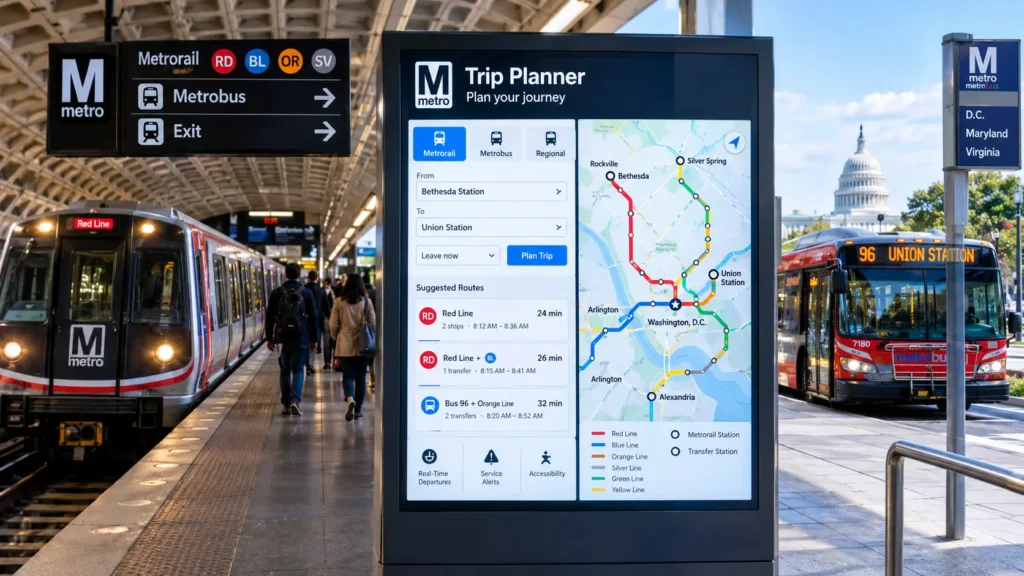
WMATA Trip Planner helps riders plan public transit journeys using Metrorail, Metrobus, and regional transit connections across Washington, D.C., Maryland, and Northern Virginia.
Your Ultimate WMATA Trip Planner Guide: Master the Washington Metro
Navigating a new city can feel like trying to solve a Rubik’s cube blindfolded. I remember my first trip to Washington, D.C. I stood at the Metro Center station, staring at the map like it was written in ancient hieroglyphs. The WMATA trip planner wasn’t even on my radar. I just jumped on the first train that came. Big mistake. I ended up in Maryland when I wanted to see the monuments.
That’s when I learned the hard way: you need a plan. You need the WMATA route planner before you even step foot in a station. The Washington Metro trip planner is your best friend. It’s the key to unlocking the city without the stress. It doesn’t matter if you’re a tourist or a daily commuter. The DC Metro trip planner saves you time and money.
This isn’t just a tool. It’s your personal guide through the chaos of the capital. Let’s dive into how to use it like a local. You’ll be navigating the Washington DC Metro system like a pro in no time.
Why You Need the WMATA Transit Planner
Think of the WMATA transit planner as your co-pilot. The Washington Metropolitan Area Transit Authority (WMATA) runs a complex system. It has six rail lines and hundreds of bus routes. Trying to memorize it all is impossible. The WMATA Metro planner does the heavy lifting for you.
Why rely on it? It gives you step-by-step directions. You just type in where you are and where you want to go. It calculates the fastest route. It tells you exactly which train to catch. It even tells you where to walk. It is the best way to plan a Metro trip without getting lost.
The DC public transportation system can be confusing. But the planner makes it simple. It shows you the transfer points. It estimates your travel time. It even tells you the fare. This is crucial for managing your budget. It takes the guesswork out of your commute.
Getting Started with the WMATA Journey Planner
Using the WMATA journey planner is easier than ordering a coffee. You just need to know your starting point and destination. You can use the official WMATA website or the app. Both are user-friendly.
Here’s how to do it:
- Go to the WMATA website or open the Metro Pulse App.
- Find the “Trip Planner” tool. It’s usually right on the homepage.
- Enter your starting address or station.
- Enter your destination address or station.
- Choose your date and time of travel.
- Hit “Plan My Trip.”
The system will generate a list of options. You can even choose your preference. Do you want the fastest route? Do you want to walk less? The Metro route finder can handle it all. It’s that simple.
Pro Tip: Using the New Metro Pulse App
In May 2026, WMATA rolled out a redesigned website and a new app called Metro Pulse. This isn’t your old WMATA app. It has an AI-powered chat feature. If you have a question, just ask the chatbot. It can help you plan your journey in real-time.
The new app also has a “Discover” tab. It shows you transit options near your current location. It gives you live arrival times. The “Favorites” tab lets you save your regular stops. This is a game-changer for regular commuters. It’s about time they made it this easy.
| Feature / Specification | Details |
|---|---|
| Official Name | WMATA Trip Planner (integrated into the Metro Pulse app & website) [citation:1][citation:4] |
| Primary Function | Provides door-to-door transit itineraries, combining Metrorail, Metrobus, and regional transit options (ART, DC Circulator, etc.) with real-time data. [citation:9][citation:12] |
| Latest Major Update |
June 29, 2025 Integrated the Better Bus Network with new routes, names, and schedules. [citation:2][citation:4] May 2026 Redesigned website and Metro Pulse app launched with AI chat and improved UX. [citation:10] |
| Core Inputs |
|
| Output / Results |
|
| Access Channels |
Website wmata.com/tripplanner [citation:1] Mobile App Metro Pulse (iOS & Android) – redesigned in May 2026. [citation:10] Third-party Apps like DC Metro & Bus, Transit, and Google Maps use the WMATA API. [citation:9][citation:12] |
| New Feature (2026) | AI Chat Support Integrated on the website and in Metro Pulse. Provides real-time answers to trip-planning questions (available 24/7). [citation:10] |
| User Experience Focus |
|
| Fare & Payment Integration | Fares are calculated based on distance and time of day. Directly links to the SmarTrip system for mobile payments and card management. [citation:7][citation:8][citation:11] |
| Data Source & Reliability | Uses official WMATA real-time data (API) for train/bus locations and service alerts. Includes planned service advisories for track work and network changes. [citation:2][citation:9] |
| Example Use Case | Planning a weekday trip from 48th and Meade St. NE to Washington Hospital Center now recommends a single C63 bus ride taking 54 minutes and costing $2.25—saving time and money compared to older routes. [citation:2] |
Understanding the WMATA Metro Routes and Map
Okay, you’ve got your plan. But how do you read the map? The WMATA Metro map is color-coded. There are six lines: Red, Blue, Orange, Silver, Yellow, and Green. Each line goes in a specific direction. The WMATA Metro routes connect the whole city.
- Red Line: Connects the Maryland suburbs to downtown.
- Blue Line: Runs from Virginia through the heart of D.C. to Maryland.
- Orange Line: Goes from Virginia to the eastern side of the city.
- Silver Line: Connects Dulles Airport to the rest of the city.
- Yellow & Green: Serve the District and connect to Virginia.
You might need to transfer. The WMATA station map will show you transfer points. You can switch between lines at stations like Metro Center or L’Enfant Plaza. Just look for the signs. The DC Metro routes are well-marked. Follow the color you need.
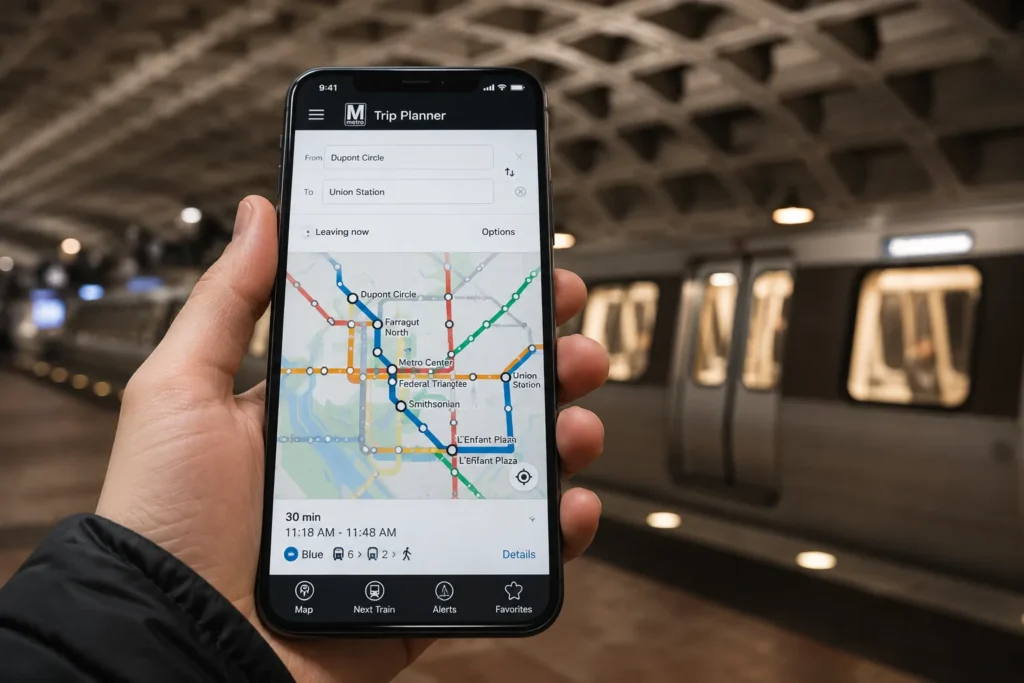
Mastering the WMATA Train Schedule and WMATA Bus Schedule
The Metro isn’t the only option. The bus system is massive. The WMATA bus schedule can be tricky. But the WMATA trip planner handles it perfectly. It includes both rail and bus options.
Navigating the Schedule:
- Peak vs. Off-Peak: Trains and buses run more often during rush hour. That’s about 7:00 AM to 9:00 AM and 4:00 PM to 6:00 PM. Fares are also higher during these times.
- Weekend Service: Schedules change on the weekend. Trains run less often. The WMATA rail service is still reliable, but plan for extra wait time.
- Real-Time Tracking: Use the app to see live train status. You can find your train’s location. You can see exactly when it will arrive at the station.
I once missed a meeting because I didn’t check the Metrobus trip planner. I assumed the bus came every 10 minutes. It didn’t. It came every 30 minutes on Saturdays. Now, I always check the Washington Metro schedule before I leave.
Practical Tools: WMATA Fare Calculator and WMATA SmartTrip Card
Let’s talk money. No one wants to get stuck at the gate because they don’t have enough fare. The WMATA fare calculator is a lifesaver.
How does it work? The WMATA trip planner will show you the fare before you travel. The price depends on distance and time. You can see the cost and plan your budget.
You need a SmarTrip card. You cannot pay with cash on the train. You also can’t use a credit card at the gate. You need a SmarTrip card. You can buy one at any station. You can also add it to your Apple Wallet or Google Pay.
- Why get a SmarTrip? It’s cheaper. It’s faster. It gives you free transfers. You get free transfers between Metrorail and Metrobus. This can save you a lot of money. The SmarTrip card is a must-have for the Metro travel planner.
Staying Informed: WMATA Service Alerts and WMATA Arrival Times
The system isn’t perfect. Track work happens. Delays happen. The Metro is constantly doing maintenance. For instance, in 2026, they finished major upgrades on the Green Line. They are also building a new entrance at Crystal City Station, which has caused closures. You need to know this stuff.
Stay in the loop:
- Check Service Alerts: The WMATA website and app have a section for service alerts. It shows current delays and elevator outages. Always check before you leave.
- Read the Signs: At the station, check the digital displays. They show the WMATA arrival times. They also show any delays.
- Sign up for Notifications: You can get email or text alerts for your specific route.
Just last month, Metro changed 50 bus routes. They added new ones like the A29. If you didn’t check the schedule, you might be standing at a bus stop that doesn’t exist anymore. The WMATA commute planner will always show the current routes. It updates with the new schedule.
How to Use WMATA Trip Planner Like a Pro
We’ve covered the basics. Now it’s time for the insider hacks. These tips will help you avoid a painful flop like getting on the wrong train.
- “Stand Right, Walk Left”: On the escalators, stand on the right. Let people pass on the left. If you don’t, you’ll get a lot of annoyed looks. It’s an unspoken rule of the Washington DC Metro navigation.
- Avoid Rush Hour: If you can, don’t travel between 7–9 AM and 4–6 PM. Trains are packed. You might have to wait for the next one. Fares are higher.
- Check the “Via” Option: In the trip planner, you can choose “less walking.” This might mean a longer train ride, but you won’t have to run for a transfer.
- Use the “Discover” Feature: If you’re lost, open the Metro Pulse app. Hit the Discover tab. It will show you the nearest stations and bus stops. It will even show you the next arrival times. It is the best way to find the Metro station finder tool.
Live Metro Train Tracker and Trip Planning Apps
The WMATA tool is great. But you have other options. Many apps use the WMATA data to help you travel.
Popular apps include:
- MetroHero: A fan favorite for real-time tracking. It shows exactly where trains are.
- Transit App: Integrates with many different cities. It’s great for seeing multiple options.
- Google Maps: It pulls in WMATA data. It is reliable for rail and bus directions.
- CityMapper: Great for comparing different modes of transport (bike, bus, train, scooter).
These apps often use the Metro travel time calculator. They show you the fastest way to get somewhere. They are great backups if the official site is slow. The best way to plan a Metro trip is to use the tools available.
The Bottom Line
The WMATA trip planner is your ticket to exploring the nation’s capital. It turns a complicated network into a simple set of instructions. It takes the stress out of the DC subway planner.
I used to dread taking the Metro. I always worried I would end up in the wrong part of town. Now, I just whip out my phone. I use the Washington Metro trip planner, and I’m set. It tells me the route. It calculates the fare. It even tells me if there’s a delay. It is the ultimate travel tool for Washington DC Metro travel.
So, don’t be like my past self. Don’t just wander onto a train. Take five minutes to plan your trip. Your feet and your wallet will thank you.
Get out there and explore! The city is waiting for you.
References
- WMATA. (2026). Metro rolls out redesigned website, Metro Pulse app. https://www.wmata.com/news/metro-to-roll-out-redesigned-website–metro-pulse-app-to-simplif.html
- WMATA. (2026). Schedules & Maps. https://www.wmata.com/schedules/
- WMATA. (2026). Metro announces upcoming service updates for Bus and Rail. https://www.wmata.com/news/metro-announces-upcoming-service-updates-for-bus-and-rail-.html
- Capitol Skyline. (2026). Washington DC Public Transit Guide. https://capitolskyline.com/washington-dc-public-transit-guide-how-to-ride/
- goDCgo. (2025). Trip Planning Tools and Apps for Sustainable Transportation in DC. https://godcgo.com/trip-planning-tools-and-apps-for-sustainable-transportation-in-dc/
Read More: Map of Europe